
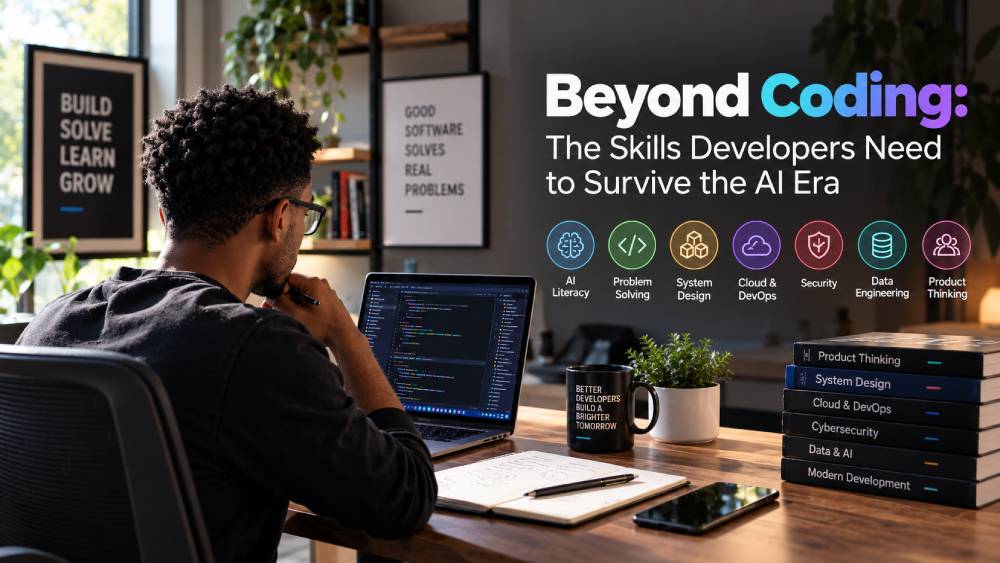
Beyond Coding: The Skills Developers Need to Survive the AI Era
Why writing code is no longer enough—and what developers should learn in 2026 and beyond.
A few years ago, writing code was one of the clearest ways to demonstrate technical expertise. Today, AI assistants can draft React components, Laravel controllers, database migrations, and tests in seconds.
But generating code and delivering dependable software are not the same thing. Code can compile and still be insecure. A feature can work and still solve the wrong problem. A polished interface can hide unreliable data processing.
So, what makes a developer valuable when code itself is easier to produce?
The answer is not to abandon programming. It is to combine programming fundamentals with judgment, architecture, security, operational knowledge, and the ability to solve real problems.
This is not a prediction that every programming job will disappear. It is a practical look at the skills that can remain useful as tools evolve.
1. The shift from writing code to delivering outcomes
Software engineering has always evolved through abstraction. Higher-level languages, libraries, frameworks, and cloud services have repeatedly reduced repetitive work. AI-assisted coding is another major step: instead of only automating predefined tasks, it can suggest implementations from natural-language requirements.
That changes how developers spend their time. More effort may go toward clarifying requirements, reviewing implementations, testing edge cases, integrating services, and monitoring production behavior.
But the change is uneven. A simple content website, a financial system, and a graphics-intensive mobile application have very different engineering constraints.
Code generation asks, “What implementation could work?” Software engineering asks, “Is it correct, safe, maintainable, and valuable?”
2. AI literacy: learn to collaborate without surrendering judgment
AI literacy is more than prompt writing. It includes knowing what AI tools do well, where they fail, and how to verify their outputs.
A useful workflow is to define acceptance criteria, supply project context, ask for design alternatives, review generated code, run tests, and validate behavior against authoritative documentation.
Consider this instruction:
Build a Laravel endpoint to record an invoice payment.
Before generating code, a responsible developer should ask whether partial payments are allowed, how duplicate requests are prevented, whether the invoice and payment must belong to the same company, and what happens when two payments arrive concurrently.
AI can accelerate the implementation, but those business rules must be explicit.
The critical skill is not getting AI to write code. It is knowing what code should do and how to prove it does so.
Developers should also understand the difference between using an AI assistant, integrating a model API, building agentic workflows, and training a model. Most developers do not need to train foundation models to create useful AI-enabled applications.
3. Programming fundamentals: your foundation beneath the tools
If AI generates a function you cannot explain, the engineering risk has not disappeared—it has become harder to see.
Master variables, functions, data structures, algorithms, type systems, modules, asynchronous programming, debugging, and testing.
For example:
const users = [{ id: 1, name: "Ada" }];
const user = users.find((item) => item.id === 2);
console.log(user.name);
This throws because find() returns undefined when there is no match. A safer version handles the missing case:
const user = users.find((item) => item.id === 2);
if (!user) {
  console.log("User not found");
} else {
  console.log(user.name);
}
Real software contains more complicated versions of the same issue: expired tokens, invalid requests, interrupted connections, missing records, and conflicting updates. Understanding execution and failure paths is more durable than memorizing framework syntax.
4. Systems thinking and architecture
Applications are collections of interacting components. Consider a payment feature:
Mobile / Web App
       ↓
Authenticated API
       ↓
Validation and Business Rules
       ↓
Payment Provider
       ↓
Confirmation / Webhook
       ↓
Database and Accounting Records
       ↓
Receipt and Notification
What if the provider succeeds but the database update fails? What if a webhook arrives twice? What if the customer retries after a timeout?
These questions require architectural judgment. Learn HTTP, APIs, relational modeling, database transactions, caching, queues, background jobs, idempotency, retries, timeouts, and observability.
Start small: trace a single request from the interface to the database and back. Identify where it can fail, what must remain consistent, and how the system recovers.
5. Cloud computing, DevOps, and deployment
Software that works on a laptop is not automatically production-ready. Developers benefit from knowing how software is deployed and maintained.
Important topics include Linux fundamentals, Git, CI/CD, Docker, DNS, HTTPS, reverse proxies, environment variables, secrets management, monitoring, backups, and rollback strategies.
You need not become an infrastructure specialist. But you should be able to answer: Where are errors logged? How is the service restarted? Can we roll back a release? How do we restore data after a failure?
Operational literacy turns a working demo into a maintainable product.
6. Cybersecurity and secure development
Security is not an optional feature added at the end. Learn authentication, authorization, input validation, secure sessions, least privilege, secret handling, and common web and API vulnerabilities.
Imagine an endpoint:
GET /api/invoices/123
Checking that a user is logged in is not enough. The application must verify that this user has permission to access that invoice. In multi-company systems, company boundaries must be enforced server-side.
AI-generated code can miss these rules, just as human-generated code can. Study the OWASP Top 10 and OWASP API Security Top 10 for structured guidance.
7. Data literacy: databases and trustworthy information
Good software depends on good data. Learn SQL, keys, relationships, constraints, indexes, transactions, migrations, and data validation.
An invoice application, for instance, should not trust a total supplied by the frontend. The backend must validate line items and calculate authoritative amounts using appropriate numeric precision.
For AI-enabled products, data quality, privacy, and provenance are especially important. A capable model cannot reliably compensate for contradictory records or missing business context.
Data engineering—pipelines, transformation, warehouses, and orchestration—is a valuable specialization, but not every developer needs to become a data engineer.
8. Full-stack literacy and integration
Specialization still matters. Excellent frontend, backend, mobile, security, and infrastructure engineers remain essential. Yet understanding adjacent layers improves collaboration and problem-solving.
A frontend developer who understands API contracts builds better error states. A backend developer who understands UX creates more usable workflows. A mobile developer who understands networking handles offline connectivity more gracefully.
Aim for T-shaped expertise: deep skill in one area, with enough breadth to understand how it connects to the rest of the product.
The goal is not to collect framework names. It is to understand how systems fit together.
9. Communication, product thinking, and business understanding
Suppose a client says:
Our website no longer attracts customers. We need a redesign.
A code-focused developer may immediately propose rebuilding the frontend. A product-minded developer asks whether traffic declined or conversion fell, where visitors leave, whether performance or messaging is the problem, and how success will be measured.
A redesign might be the right answer—or it might be an expensive distraction.
Understanding the business problem is a technical advantage. It helps developers build the right solution, not merely implement the requested solution.
10. Are programming languages becoming less important?
AI can generate JavaScript, Python, PHP, Java, Go, Rust, and other languages. That may reduce the value of memorizing syntax and manually producing boilerplate.
But languages still differ in runtimes, type systems, concurrency models, ecosystems, deployment requirements, and performance characteristics.
Knowing JavaScript means understanding promises, the event loop, objects, modules, and runtime behavior—not just remembering arrow-function syntax. Knowing PHP means understanding request lifecycles, dependencies, server execution, and application architecture.
Learn one language deeply enough to reason in it. Add others when your projects justify them.
11. From code writer to problem solver
Imagine two developers.
Developer A writes components and endpoints quickly but struggles when requirements are ambiguous or systems fail.
Developer B also writes code, but clarifies requirements, designs data models, anticipates failure, checks security, writes tests, and evaluates business outcomes. Developer B uses AI to accelerate routine work without delegating responsibility.
For many complex projects, Developer B is better positioned to deliver lasting value.
This does not make implementation expertise unimportant. It makes that expertise more valuable when paired with judgment and ownership.
12. A practical learning roadmap
Nobody needs to master every skill at once. Build foundations, choose a specialization, and expand deliberately.
| Career stage | Priority skills | Practical project |
|---|---|---|
| Beginner | One language, Git, debugging, SQL, HTTP | CLI tool and CRUD API |
| Junior | Testing, APIs, authentication, AI workflows, deployment | Deploy a secure application |
| Mid-level | Architecture, database design, CI/CD, security, observability | Build reliable integrations and background jobs |
| Senior | Trade-offs, leadership, reliability, product strategy | Lead a feature from discovery through measurable results |
A 90-day learning plan
Days 1–30: Strengthen the foundation. Build a small program, write tests, and practice explaining how it works. Use AI selectively and verify its suggestions.
Days 31–60: Connect the system. Add an API, relational database, authentication, validation, and useful error handling. Trace data across layers.
Days 61–90: Ship and operate. Deploy your application, configure CI, logging, and backups, review security, and collect real user feedback.
At the end, you should have experience making engineering decisions—not simply following a tutorial.
13. What developers should avoid
Chasing every new framework. Understand why tools exist before adopting them.
Trusting AI output without verification. Generated code and tests can overlook requirements and security boundaries.
Skipping fundamentals. Without them, subtle errors become harder to detect.
Trying to specialize in everything. Depth matters; breadth should support it.
Treating job-market forecasts as guarantees. Hiring needs vary by geography, company, industry, and economic conditions.
14. The most future-proof skill: learning how to learn
Some tools will lose popularity; new platforms will emerge; AI assistants will become more capable. You cannot freeze your skills in 2026 and expect them to remain sufficient forever.
Build a repeatable learning process: understand the problem, read documentation, test assumptions, build small experiments, compare trade-offs, and learn from production failures.
The goal is not to predict every technology that will matter in 2030. It is to become the developer who can adapt when 2030 arrives.
Conclusion: beyond coding does not mean without coding
AI is changing how software is produced. Routine implementation may become faster, but dependable software still requires architecture, security, testing, operational awareness, and human judgment.
The developers best positioned for the AI era will neither reject AI nor trust it blindly. They will combine strong fundamentals, modern tools, and responsibility for the result.
Keep learning to code. Then keep going beyond it.
References and further reading
These sources provide industry context and practical guidance. The recommendations above are an editorial synthesis, not guarantees about future employment.
- Stack Overflow Developer Survey — developer practices and attitudes toward AI.
- GitHub Octoverse — software development trends.
- World Economic Forum — Future of Jobs Report 2025 — broader skills and employment trends.
- Google Cloud DORA research — software delivery performance.
- MDN Web Docs — JavaScript and web fundamentals.
- OWASP Top 10 — web security risks.
- OWASP API Security Top 10 — API security guidance.
- Docker documentation — containers and deployment.
- PostgreSQL documentation — SQL and relational database fundamentals.
Keep exploring
Software makes more sense when the fundamentals are clear.
Understanding Asynchronous Programming with Promises and async/await in JavaScript and TypeScript
Learn how JavaScript handles asynchronous operations with Promises and async/await — from callbacks to modern async flows, with real examples in both JS and TypeScript.
CommonJS vs ESM: Understanding Both JavaScript Module Systems
A clear explanation of the two main module systems in JavaScript — CommonJS and ES Modules (ESM) — how they work, their differences, and how to use them in Node.js, TypeScript, and Bun.